

The Differences Between SBA Loans and Merchant Cash Advances
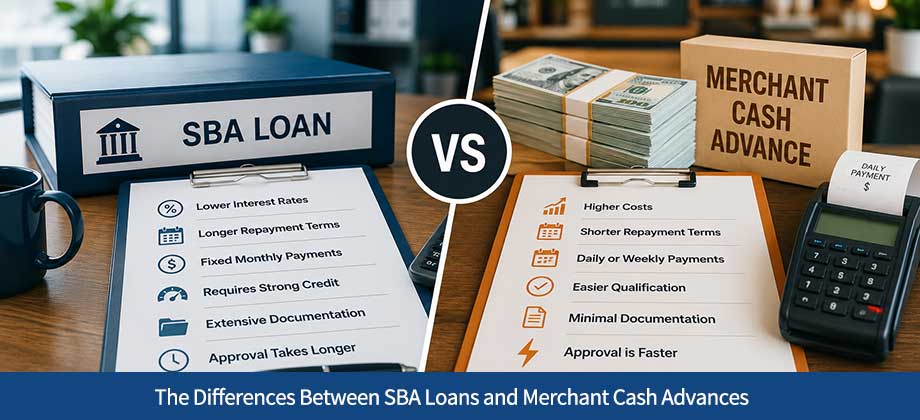
When small business owners need capital, two financing options frequently appear in their search results: SBA loans and merchant cash advances (MCAs). While both can provide access to funds, they’re actually fundamentally different products designed for different situations. Understanding the differences between SBA loans and merchant cash advances can help business owners choose the financing solution that best fits their needs, cash flow, and growth plans. Ready to dive in?
What Is an SBA Loan?
An SBA loan is a small business loan issued by a participating lender and partially guaranteed by the U.S. Small Business Administration (SBA). The SBA doesn’t directly lend the money in most cases; instead, it reduces lender risk by guaranteeing a portion of the loan. According to the SBA, its flagship 7(a) loan program can be used for working capital, equipment purchases, business acquisitions, real estate, and debt refinancing.
Because of the government guarantee, SBA loans typically offer lower interest rates and longer repayment terms than many alternative financing products. And when it comes to repayment, terms can extend up to 10 years for working capital and up to 25 years for real estate-related loans.
What Is a Merchant Cash Advance?
A merchant cash advance isn’t technically a loan. Instead, an MCA provider purchases a portion of a business’s future sales in exchange for an upfront lump sum. Repayment is typically collected through a percentage of daily or weekly credit card sales or bank deposits. According to the Federal Trade Commission (FTC), MCAs are generally easier to obtain than traditional loans but often come with significantly higher financing costs. Because repayment is tied to revenue, businesses may qualify even if they have limited collateral or weaker credit profiles.
How Do SBA Loans and MCAs Compare?
Approval Requirements
SBA lenders generally evaluate several factors before approving a loan, including cash flow, business performance, credit history, management experience, and repayment ability. The SBA’s lending standards are designed to ensure borrowers can reasonably repay the debt.
Merchant cash advance providers typically place greater emphasis on sales volume and revenue trends. Businesses with strong daily sales may qualify even if they would not meet traditional lending requirements.
Funding Speed
One advantage of MCAs is speed. Many providers can approve and fund businesses within a matter of days. SBA loans, however, often require more documentation and underwriting. Depending on the lender and loan type, approval can take several weeks—but recent SBA modernization efforts have streamlined portions of the application process, helping some borrowers receive decisions more quickly.
Cost of Capital
This is where the difference becomes most significant.
SBA loans generally carry some of the lowest borrowing costs available to small businesses. Interest rates are capped by SBA guidelines and are often tied to the prime rate.
Merchant cash advances, on the other hand, typically use factor rates instead of traditional interest rates. Industry analyses have found that the effective annual percentage rate (APR) on some MCAs can exceed 50 percent and, in certain cases, reach triple-digit percentages.
Repayment Structure
SBA loans usually feature fixed monthly payments over a predictable repayment schedule, which can make budgeting easier and help businesses manage long-term cash flow.
MCAs are repaid through frequent deductions from sales or bank deposits. While payments may fluctuate with revenue, the frequent withdrawals can place pressure on daily operating cash flow. The FTC advises business owners to carefully evaluate how these repayment structures could affect their finances.
Which Option Is Better?
The answer depends on your business’s circumstances.
An SBA loan may be the better choice for businesses seeking lower costs, predictable payments, and long-term financing for growth initiatives such as expansion, equipment purchases, acquisitions, or working capital. A merchant cash advance may be considered when a business needs immediate access to funds and can’t qualify for conventional financing, though owners should carefully weigh the higher costs and cash flow implications.
For many businesses, the best financing solution is the one that balances speed, affordability, and long-term sustainability.
At ARF Financial, we understand that every business faces unique financing challenges. Whether you’re exploring SBA loan options, seeking working capital, or evaluating alternative financing solutions, we’re here to help you make informed funding decisions. For more insights on SBA lending, business financing, and small business growth strategies, visit us at the Financial Pantry and stay up to date on the trends shaping today’s business landscape.
Your privacy is important to us. ARF Financial will never sell or rent your information to any third party. Click here for more information about our privacy policy.