

The American Dream Is Built by Small Business Owners
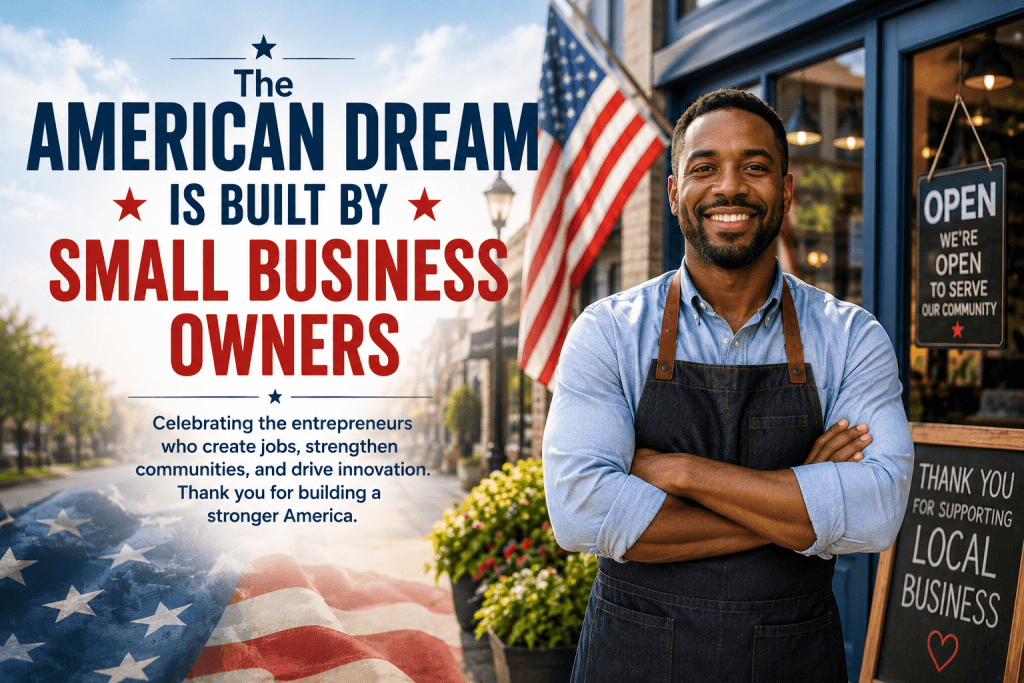
Small business owners are the backbone of the American economy—creating nearly half of all private-sector jobs, driving local innovation, and strengthening communities across the country. This Independence Day, their entrepreneurial spirit deserves recognition as one of the truest expressions of the American Dream.
Every Fourth of July, Americans celebrate the ideals of freedom, independence, and the pursuit of something greater. Fireworks light up the sky, flags line the streets, and families gather to mark the birth of a nation. But behind the parades and the patriotism, there’s a quieter story worth telling—one written not in history books, but in storefronts, workshops, and late-night spreadsheets.
Small business owners are living proof that the American Dream is still alive. They’re the bakery owner who starts at 4 a.m. so the neighborhood wakes up to fresh bread. The software developer who left a corporate salary to build something on her own terms. The family that turned a basement hobby into a thriving local brand. These aren’t just feel-good stories—they’re the economic engine of the United States.
According to the U.S. Small Business Administration (SBA), there are over 33 million small businesses in the United States, accounting for 99.9% of all U.S. businesses. They employ nearly 46% of the private-sector workforce. That’s not a footnote in the economy—that’s the headline.
This Independence Day, it’s worth pausing to understand just how much small business owners contribute to the fabric of American life, and why their continued investment in their vision matters more than ever.
How do small businesses shape the American economy?
The numbers tell a compelling story. Small businesses create roughly two out of every three net new private-sector jobs in the United States, according to the SBA. When a local business hires a new employee, that ripple effect touches the whole community—more spending at nearby restaurants, higher demand for local services, and a stronger tax base for schools and infrastructure.
But economic impact goes beyond job creation. Small businesses generate approximately 44% of U.S. economic activity, according to SBA data. They are disproportionately represented in sectors like construction, professional services, retail, and food service—industries that touch everyday American life at nearly every turn.
The relationship between small businesses and the broader economy is circular. Strong communities support small businesses. Strong small businesses build stronger communities.
What role do small business owners play in driving American innovation?
Large corporations often get credit for innovation, but small businesses punch far above their weight class in this category. According to the SBA, small businesses produce 16 times more patents per employee than large companies. They’re faster to adapt, quicker to experiment, and less burdened by corporate bureaucracy.
Many of America’s most transformative companies started as small businesses. Apple famously launched from a garage in Cupertino. Amazon began as an online bookstore run out of Jeff Bezos’s home. The throughline from humble beginnings to category-defining success is a distinctly American story—and it starts with an entrepreneur willing to bet on themselves.
Today’s small business owners are doing the same. They’re developing new software tools, pioneering sustainable farming practices, launching community-focused healthcare services, and reimagining what local retail can look like in a digital age. Innovation doesn’t always come from Silicon Valley boardrooms. Sometimes it comes from a food truck in Austin or a design studio in Detroit.
How do small businesses strengthen local communities?
Walk down the main street of almost any American town and you’ll see it: the hardware store that’s been family-owned for three generations, the coffee shop that doubles as a community hub, the bookstore that hosts author readings on Friday nights. These businesses don’t just sell products—they anchor neighborhoods and shape local identity.
Small businesses donate to local charities at twice the rate of large businesses, according to research cited by the Small Business Administration. They sponsor Little League teams, fund school fundraisers, and show up when their communities need them most. During the COVID-19 pandemic, many small businesses pivoted quickly to serve their communities—producing hand sanitizer, delivering groceries, and keeping essential services running under enormous pressure.
There’s also a multiplier effect at play. For every dollar spent at a local small business, approximately 67 cents stays within the local economy, compared to just 32 cents when spending at a large chain, according to the American Independent Business Alliance. Choosing to support a small business is, in a very real sense, an investment in the place you live.
What challenges are small business owners facing today?
Celebrating small businesses doesn’t mean ignoring the obstacles they face. Entrepreneurship in America is demanding—and the current landscape presents real pressures.
Rising costs remain a persistent concern. Inflation, supply chain disruptions, and increasing labor costs have squeezed margins for small business owners across industries. According to the National Federation of Independent Business (NFIB), inflation was cited as the single biggest problem for small businesses throughout much of 2022 and 2023.
Access to capital is another significant barrier. While programs like SBA loans exist to help, many small business owners—particularly those from underserved communities—still face substantial hurdles when seeking funding. The Minority Business Development Agency has documented persistent gaps in financing access for minority-owned small businesses, a problem that limits both individual opportunity and broader economic potential.
Then there’s competition. E-commerce giants and big-box retailers have fundamentally changed consumer behavior. Small business owners must work harder to differentiate, build loyalty, and communicate their value proposition clearly.
Yet, despite these challenges, entrepreneurship remains one of the most enduring expressions of the American spirit. Approximately 5 million new business applications were filed in the United States in 2023, according to U.S. Census Bureau data—the third consecutive year of historically high startup activity.
Why is Independence Day the right moment to honor entrepreneurs?
Independence Day is a celebration of freedom—specifically, the freedom to determine your own path and build something that didn’t exist before. That’s exactly what every small business owner does when they decide to start a company.
The Declaration of Independence articulates the right to “life, liberty, and the pursuit of happiness.” For millions of Americans, that pursuit looks like building a business, creating jobs, and leaving something meaningful behind. Entrepreneurship isn’t just economic activity—it’s a deeply personal expression of freedom.
When a small business owner hires their first employee, they’re extending opportunity. When they invest in a neighborhood location, they’re committing to a community. When they stay open through hard times, they’re demonstrating exactly the kind of resilience the country was built on.
There’s a reason the “self-made” narrative is so central to American culture. It reflects a genuine belief—tested and proven again and again—that hard work, ingenuity, and determination can take you somewhere real. Small business owners are the living embodiment of that belief.
How can Americans support small business owners this Independence Day?
Recognition matters, but action matters more. There are tangible ways to show support for the small business owners who contribute so much to American life.
Shop local whenever possible. Before defaulting to a large retailer or online marketplace, check whether a local business offers the same product or service. The additional cost—if there is one—is often modest, and the impact is significant.
Leave a review. Online reviews are a primary driver of new customer acquisition for small businesses. A detailed, honest review on Google or Yelp costs nothing and can meaningfully affect a business’s visibility and reputation.
Spread the word. Recommending a favorite local business to friends, family, or colleagues is one of the most effective forms of marketing a small business can receive—and it’s entirely free.
Advocate for supportive policy. Local and federal policies on taxation, regulation, and access to capital directly affect small business viability. Staying informed and advocating for policies that remove unnecessary barriers supports entrepreneurs across the board.
The American Dream Is Still Being Written
The American Dream has never been a fixed destination. It’s a moving target—shaped by each generation that chases it and every entrepreneur who decides to build something from scratch.
Small business owners carry that tradition forward every single day. They take risks, create jobs, serve their communities, and prove—quietly, consistently—that the freedom to try is one of the most powerful forces in the world.
This Fourth of July, raise a glass to the entrepreneurs. Not just for what they’ve built, but for the belief that drove them to start. That belief—stubborn, optimistic, and unmistakably American—is the real foundation of the Dream.
If you’re a small business owner, keep going. Your vision matters more than you know.
Frequently Asked Questions
How many small businesses are there in the United States?
According to the U.S. Small Business Administration, there are over 33 million small businesses in the United States. They represent 99.9% of all U.S. businesses and employ nearly 46% of the country’s private-sector workforce.
How much do small businesses contribute to the U.S. economy?
Small businesses generate approximately 44% of U.S. economic activity, according to SBA data. They also create roughly two out of every three net new private-sector jobs, making them one of the most significant drivers of employment and GDP growth in the country.
Are small businesses more innovative than large corporations?
Per SBA research, small businesses produce 16 times more patents per employee than large companies. Their agility, lower bureaucratic overhead, and entrepreneurial culture allow them to experiment and adapt faster than larger organizations.
What are the biggest challenges facing small business owners today?
The most significant challenges include inflation and rising operating costs, limited access to capital (particularly for minority-owned businesses), and increased competition from large online retailers and e-commerce platforms. Despite these pressures, new business applications in the U.S. have remained at historically high levels since 2021.
Why is Independence Day associated with entrepreneurship and small business?
Independence Day celebrates the core American values of freedom, self-determination, and the pursuit of opportunity—values that align closely with entrepreneurship. Starting a business is one of the most direct ways individuals exercise economic freedom in America, making July 4th a meaningful moment to recognize the role small business owners play in sustaining the American Dream.
How can consumers support small businesses in their community?
Consumers can support local small businesses by shopping locally, leaving detailed online reviews, referring friends and family, and staying informed about policies that affect small business viability. Research from the American Independent Business Alliance shows that approximately 67 cents of every dollar spent at a local business stays within the local economy.
Your privacy is important to us. ARF Financial will never sell or rent your information to any third party. Click here for more information about our privacy policy.