

Inside the K-Shaped Economy (And Why Small Businesses Should Care)
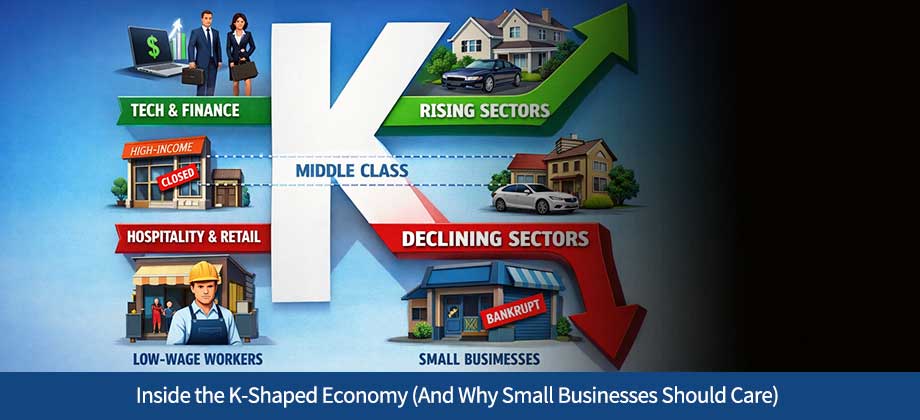
With so much lingo out there about the economy, it can be hard to know what people are talking about! Recently we’ve been hearing a lot about the “K-shaped economy,” and we thought it would be great to do a deeper dive into what that actually means. Let’s get into it…
A K-shaped economy describes a recovery or economic period in which different parts of the economy move in opposite directions: some industries, households, and workers recover quickly and even prosper, while others stagnate or fall further behind. That divergence creates two “arms” of a K: an upward arm for winners, and a downward arm for losers, rather than a single, shared rebound.
The term became widely used during and after the COVID-19 downturn to capture how tech, finance, and asset-heavy sectors boomed, all while hospitality, leisure, low-wage retail, and their workers suffered prolonged losses. Researchers at the U.S. Bureau of Labor Statistics documented that lower-wage establishments experienced the steepest and most persistent employment declines, illustrating the uneven nature of the recovery.
But why is the idea resurfacing now? Recent reporting shows that the same split is reappearing as factors like uneven inflation-adjusted wage gains, strong asset prices, and technology investments (especially AI) continue to benefit higher-income households and certain corporations, while many middle- and lower-income households face weak real income growth and tighter budgets. A recent Associated Press explainer walks through how rising stocks and corporate profits can coexist with wage pressures and fragile consumer demand for lower-income groups.
What the K-shape looks like in daily life
Practically speaking for small businesses, a K-shaped economy shows up as mixed signals: luxury and premium goods might remain in demand, while basic-goods and budget segments see shoppers pull back; local restaurants and service businesses may still be hurting, even while local real-estate or tech firms are hiring aggressively. Policy choices and the structure of industries can deepen these divergent outcomes, so targeted policy responses really matter for rebalancing growth.
The K-shape can also entrench inequality: windfalls in asset values (stocks, housing) disproportionately lift wealthier households, while workers in lower-paid, in-person jobs face job loss, scarring effects, and slower wage recovery. Analyses of the long-term impacts of the COVID K-shaped recovery warn that, without action, these patterns can harden into persistent disparities in income and opportunity.
What to watch, and what to do
- Read demand signals closely. If your customers skew toward higher incomes or luxury markets, you may see sturdier spending; if you serve lower-income or price-sensitive shoppers, demand could feel weak. Adjust inventory, pricing, and promotions accordingly.
- Mind workforce shifts. If local employers in tech or finance are hiring, talent competition may intensify; conversely, if core customer groups are under strain, labor supply and wage expectations may change. Check out the BLS research on wage-level impacts for more useful details.
- Focus on resilience and diversification. Consider diversifying revenue streams (subscriptions, services, online sales) and building cash buffers so a partial economy-wide recovery doesn’t leave your business exposed.
- Engage with community and policy. Local advocacy for workforce development, targeted support, or small-business relief can help address the uneven effects that create and extend a K-shaped economy.
A K-shaped economy isn’t an abstract academic concept—it’s a practical description of a split recovery where winners and losers diverge sharply. For small businesses, that means paying attention to which “arm” your customers and workers sit on, adapting strategy to shifting demand, and supporting community solutions that help narrow the gap. Stay tuned to the Financial Pantry for even more deep dives into economic trends.
Your privacy is important to us. ARF Financial will never sell or rent your information to any third party. Click here for more information about our privacy policy.